Showing posts with label Conventions. Show all posts

Monday, 8 December 2014

GENRE - ROMANCE CONVENTIONS/INSPIRATIONS: Flashdance, Pretty in Pink, Footloose

Romance conventions and how they might potentially inspire aspects in out film 
The films I looked at:
Pretty in Pink 
Footloose
Flashdance

Key Features in Footloose
I looked at both the original (1984) and the remake (2011).

Sound: In both movies they have the title track, Footloose, this is an iconic 
song and really fits with what the characters are doing. As this is the final 
dance scene of the movie it also creates a good ending for the film, the 
audience are left with the new equilibrium and its a happy one which is 
only enhanced by the up-beat tempo of this song.

Final Dance, Kevin Bacon 


Cowboy hat and neck tie
Costume: In the 2011 version, one of the main protagonists wears a suit but with a cowboy hat and neck tie.
Inspiration: This costume is similar to what we described for our quirky male character's costume as we spoke about having a hat, shirt and then the neck tie.


Key features in Pretty in Pink

Location: One of the most iconic scenes from Pretty in Pink is the record shop scene in which Duckie mimes along to Otis Reddings Try a little tenderness
Inspiration: As I have said before, we thought about using the scene from Pretty in Pink
where Duckie walks in to the shop and dances in our film, so as we would want intertexuality in this, we would want to try and get as close to the actual location as possible. Also,
Duckie dancing in the record shop
if we were to do a school scene instead of the dance scene, the classrooms are an idea of what we could have instead.

Sound: This scene features Try a little tenderness
Inspiration: Again, if we were to use the idea of intertexuality in our film opening then we would want to use similar music as to what is 
in this particular scene. 

Our basic idea of costume for quirky male.


Costume: Duckie wears a blazer, white shirt, cowboy neck tie, hat and glasses. Molly Ringwald's character also wears quirky vintage clothes. 
Inspiration: A lot of the costume in this film stood out for me, when we are first introduced to Duckie's character, his outfit is almost exactly what we had in mind for our quirky male. Molly Ringwald's character also is a strong representation of how we were thinking we wanted our main female character to look like.

Key features in Flashdance

Mise-en-scene and inspiration: As this film is set in the 80's it had some really 
good examples of mise-en-scene we could use, for example the
 record player in the final dance scene and throughout, we have 
talked about having a record player in our bedroom scene. This 
shot is also very similar to that in the opening scene of Billy Elliott, 
as is the entire storyline.
Close up of record player
Character and inspiration: The main protagonist in 
this film is similar to how we would 
want to portray our quirky characters, 
an outcast, someone who doesn't fit in
 etc. As I've said there are some very 
close relations between this film and 
Billy Elliott.


Extreme long shot of the room
Sound: Similar to Footloose, this film 
has an iconic song in it too which lifts 
the atmosphere and tension of what is 
going on in the scene.


Wednesday, 26 November 2014

GENRE - ROMANCE CONVENTIONS: Heathers, Rushmore, Girls just want to have fun, She's all that

I have looked at the films:
Heathers
Rushmore
Girls just want to have fun
She's all that 

Key features in each film that stood out for me were these:
In 'Heathers'
 Character- One of the lead role, played by Christian Slater, is the 'bad boy' which is a dangerous character who is usually very handsome, dressed in black, riding a motorcycle and bad influence whilst also being disruptive at school. Other common features of a bad boy are that they smoke, drink, have a husky voice and swear. 
Costume- The clothes worn are the fashionable clothes of the 1980's. These could influence our main character as she will be wearing retro vintage clothing, consisting of oversized blazers with large shoulder pads, bright block colours or complex patterns, tartan and tennis skirts. This could also link to make-up as they have distinctive bright eye make-up on when going out and volumed curled hair.


Titles- The 'produced by' is in swirly curled writing typical of a romantic film and shows that this film is focused more at a female audience. The names are all in blocked white and red font which shows that it is a high school film. The wording is quite formal as they use the phrase "produced by" rather than "made by".

 'Rushmore'

Titles- The text position moves around the shot which looks vey affective as it also changes colour depending on the background it is placed. Also the colour varies from white to black but the main title is a bright red which looks very effective whilst also connoting that the film is a romantic or romcom film

 Mise-en-scene- The headmasters room contains a lot of dark wood and leather furniture. This isn't the exact style of furniture that we would go for but the full packed and obvious mise-en-scene is what our room will be like. 


Shot types- one of our shots maybe of a book showing the name of our chosen male protagonist so this type of shot is very effective as it uses the rule of thirds. 
 Also this shot of a newspaper that would also link to mise-en-scene relates to our film as we wanted our male protagonist to stand out as being an individual and him holding a newspaper would clearly show that. 

'Girls just want to have fun'

Titles- The font is bold and a bright orange colour stereo typical of rom-coms. Used the phrase "directed by" but not a "Alan Metter film".


Mise-en-scene- This retro Tv would fit with or retro style of mise-en-scene.
Costume- The outfits worn were typical of youths in the    80's again.

'She's all that'

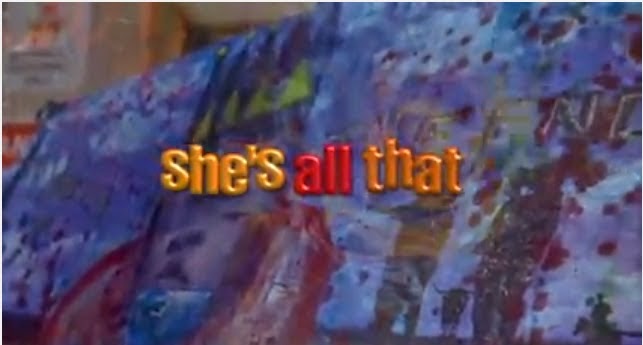
 Titles- Again the font is brightly coloured using the most popular colours of a rom-com orange, yellow and red. This time the text is rounded and smooth but still bold.
Characters- As our female and male protagonists will be outcasts the main female character in 'She's all that' is a perfect example as you can tell immediately that she is a quirky individual. (Costume + Props + Make-up) This is shown by her holding art pads and paints when walking around school whilst also wearing glasses with messy tied up hair, no make up and ripped dungarees with brightly coloured teeshirts that gave her a tomboy look. The male character in 'She's all that' is a stereo typical posh popular boy like in 'Pretty in Pink' (Costume) he wore plainish clothes like jeans and tee-shirts as well as a varsity jacket. We may cast a character much like this as a love interest

Thursday, 13 November 2014

GENRE – SOCIAL REALIST CONVENTIONS: Sweet Sixteen, A room for Romeo Brass, 247, Mickybo and me, This is England

The social realist films that I have looked at are:

  1. Sweet Sixteen (directed by Ken Loach in 2002) set in Scotland in 2002
  2. A room for Romeo Brass (directed by Shane Meadows in 1999) set in working class Nottingham in 1999
  3. 247 (directed by Shane Meadows in 1997) set in a typical English working-class town in 1980s
  4. Mickybo and me (directed by Terry Loane in 2004) set in Ireland (Belfast) in 1970
  5. This is England (directed by Shane Meadows in 2006) set in England (mostly filmed in Nottingham) in 1983

Common Themes

  • A few of the films are set in the past (Mickybo and Me and This is England) usually during a time of political or in Mickybo and Me religious conflict. For example in Mickybo+me, set back in the 1970s, Belfast is divided by the religious conflict between the Catholics and the Protestants. This creates an unlikely friendship between the two young boys "whose friendship breaks down the barriers" (taken from the blurb of the DVD case). In This is England, set back in 1983, there is the conflicts of "dealing with the bitterness of outside influences such as racism and xenophobia, of mass unemployment and the fall out of the Falkland's War; Thatcher's Britain" (taken from http://www.imdb.com/title/tt0480025/). Also 2407 "denounces Margret Thatcher's 1980s and its reproductions on England's suburbs". (Taken from the blurb)
  • All of these films are located or mainly set in working class areas, for example Sweet Sixteen is set in "the estates of Greennock",  in A Room for Romeo Brass make "exemplary use of working-class Nottingham Locations" (taken from the blurb of the DVD) and 247 is set in England's suburbs.


  • 4/5 of these films contain a young main character/protagonist and all of them are male this shows that they are very male orientated. The only one that doesn't have a main young protagonist is 247 but it still does contain central younger characters. For example This is England's main character Shaun is 14  (left) and Sweet Sixteen's main protagonist is 15 year old Liam (right).


These themes reoccur or are mentioned repeatedly in the majority of the films
1. Drugs- Sweet 16 when Liam is forced by his farther to try and smuggle drugs over to his mother in prison.

2. swearing- is in all of these films.

3. violence- in all for example when Shaun in This is England gets into a fight with an older boy at school or in Sweet Sixteen when Liam is beaten up by his farther and uncle.

4. 'chavy' clothes - especially in Sweet 16 and 2407, but this isn't present in This is England as they wear clothes in the style of mod.
chavy costumes in Sweet Sixteen


5. chase scene- sweet 16 as they are chased by the police after vandalising a police bike, in mickybo+me when Mickybo is chased by older boys on his block for stealing their ball.

6. gang- in 2407 when we see the two rival gangs fighting over chips, mickybo+me when Mickybo says "Are you in a gang" and in This is England, but it is seen as a less violent gang that is more like a family than a gang that Shaun first comes into contact with compared to the violent racist gang he joins later.
Conventions 
  • Location Shooting - The locations that are shot in social realist films are usually shot in a natural, realistic environment such as council estates or parks without the use of a studio unlike big Hollywood films.
  • Types of Shot's - Usually in social realist films a lot of establishing shots are used to give the audience a bigger insight of the environment. Also handheld camera's are used a lot in a documentary style to get the preferred reading of a real life film.
  • Unknown Actors - Normally unknown actors are used purely because film company's who produce social realism films cannot afford A-list stars to act for them.
  • Semi-improvised scripts - Sometimes directors such as Ken Loach use semi-improvised scripts to make the film have more 'realistic' dialogue. He used this in the film 'Kes'.
  • Social Issues - Many social issues are explored in social realist films such as in 'The Full Monty' where we see the issue of unemployment explored.
  • Religious View's - Religious view's are shown in social realist films for example in 'East is East', the conflict between the farther being a committed muslim and the rest of his children wanting to be normal children growing up in Britain.
Music

  • A varied use of music styles are used for example in Mickybo+me where upbeat Jazzy music is used to reflect the fast chase scene but also to dim out the violent side to this angry chase.  
  • But in other films for example 247 the music is very subtle and light using strings which creates a more emotional mood which contradicts with the violence of the boxing. 

Tuesday, 4 November 2014

GENERAL FILM OPENING CONVENTIONS


This is my video basically explaining what I have learned about the general conventions of film openings from my previous research. In this video I look at narrative enigma, Over the shoulder shots and establishing shots.